
Protocol, Labs, Foundation
To begin, we should clarify the distinctions between the different areas of “Opencharge,” some of which may confuse new users.Opencharge Labs
The company responsible for developing the Opencharge protocol specifications, reference implementations, and developer tools. Labs drives the technical roadmap and builds products that showcase the protocol’s capabilities.
Opencharge Foundation
A non-profit organization that supports the development and adoption of the Opencharge protocol. The Foundation manages grants, facilitates community governance, and coordinates among ecosystem stakeholders.
Opencharge Protocol
The core specification—a set of open, versioned standards that define how payment services, wallets, and hardware devices communicate. The protocol itself is not software but a technical specification that anyone can implement.
Opencharge SDKs
Reference implementations and software development kits that help developers integrate the Opencharge protocol into their applications. These are maintained by Labs but open source for community contribution.
Opencharge Sandbox
A testing environment and web interface that allows developers to simulate and validate their Opencharge implementations. The sandbox is only one of many ways to test protocol compliance.
Opencharge Governance
A governance system for evolving the Opencharge protocol, enabling stakeholders—wallet providers, device manufacturers, and developers—to propose and vote on protocol changes.
Opencharge Labs
Opencharge Labs is the for-profit company that initiated the Opencharge protocol and continues to drive its development. Labs is responsible for authoring new protocol versions, maintaining reference implementations, and building developer infrastructure.Protocol Development
Authors and maintains the official Opencharge specification documents, ensuring technical rigor and backwards compatibility.
Reference SDKs
Builds and maintains open-source SDKs in multiple languages (JavaScript, Python, Go, Rust) to accelerate developer adoption.
Developer Tools
Creates testing tools, validators, and debugging utilities that help implementers and developers to test and verify protocol compliance.
Commercial Products
Builds commercial products and services on top of the protocol, demonstrating its capabilities and generating sustainable revenue.
- Drafting new protocol specifications and extensions
- Maintaining official reference implementations
- Providing technical leadership and support
- Building infrastructure for the ecosystem
Opencharge Foundation
The Opencharge Foundation is an independent non-profit organization established to support the long-term health of the protocol ecosystem. The Foundation operates separately from Labs to ensure community interests are represented.Grants Program
Funds developers, researchers, and organizations building on or contributing to the Opencharge ecosystem.
Governance Facilitation
Coordinates the governance process, ensuring all stakeholders have a voice in protocol evolution.
Ecosystem Growth
Promotes adoption through events, partnerships, educational content, and developer relations.
Certification Program
Manages the compliance certification program that verifies implementations meet protocol standards.
- Managing the grants budget and funding allocation
- Facilitating governance proposals and voting
- Organizing community events and working groups
- Maintaining neutrality between competing implementations
Opencharge Protocol
The protocol itself is a set of technical specifications—not software. It defines the message formats, communication patterns, and behavioral contracts that enable interoperability between payment systems.Core Specification
Defines fundamental message types, authentication flows, and transaction lifecycles.
Wallet Extension
Specifications for wallet-to-wallet communication, including payment requests, confirmations, and receipts.
Device Extension
Specifications for hardware device integration, including vending machines, point-of-sale terminals, and IoT devices.
Discovery Extension
Specifications for service discovery, capability broadcasting, and network registration.
- Versioned: All specifications are versioned to ensure backwards compatibility
- Modular: Extensions can be adopted independently based on use case
- Permissionless: Anyone can implement the protocol without approval
- Neutral: The protocol does not favor any particular wallet, currency, or provider
Opencharge Governance
Governance enables the community to evolve the protocol over time. Unlike centralized standards bodies, Opencharge governance is designed to be transparent, inclusive, and community-driven.Proposal Process
Anyone can submit an Opencharge Improvement Proposal (OCIP) to suggest changes or additions to the protocol.
Working Groups
Specialized groups focus on specific areas like security, hardware integration, and regional compliance.
Voting
Stakeholders vote on proposals after community discussion and technical review periods.
Implementation
Approved proposals are incorporated into official specifications and reference implementations.
Governance Participants
| Stakeholder | Role |
|---|---|
| Wallet Providers | Vote on proposals affecting wallet-to-wallet communication |
| Device Manufacturers | Vote on proposals affecting hardware integration |
| Developers | Contribute to discussions and submit improvement proposals |
| Foundation | Facilitates process, does not vote on technical matters |
| Labs | Provides technical guidance, one vote among many |
How They Work Together
The separation of concerns ensures healthy checks and balances within the ecosystem.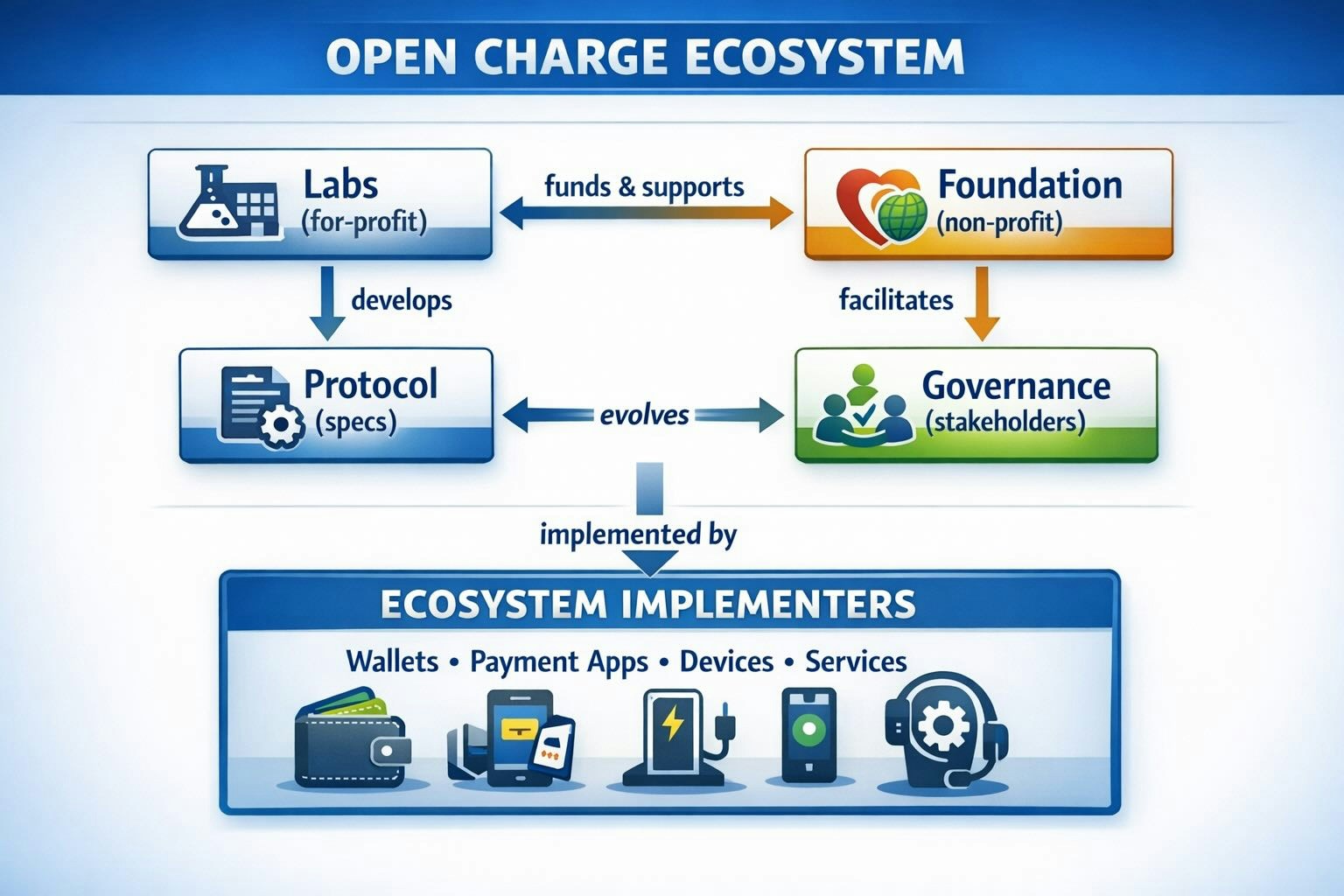
Labs → Foundation
Labs contributes funding and technical resources to the Foundation, but the Foundation operates independently.
Foundation → Governance
The Foundation facilitates governance but does not control it. Stakeholders make decisions collectively.
Governance → Protocol
Approved governance proposals go through a voting process to become official protocol specifications.
Labs → Protocol
Labs authors specifications but cannot unilaterally change the protocol without governance approval.
Why This Structure?
Lessons from Uniswap and other protocols
This structure draws inspiration from successful decentralized protocols like Uniswap, which separates Labs (development), Foundation (ecosystem support), Protocol (smart contracts), and Governance (token holders). For Opencharge, we adapt this model for a communication protocol rather than a DeFi protocol.
Decentralization
No single entity controls the protocol. Labs can drive development, but governance has final say.
Sustainability
Labs generates revenue through commercial products, while funding continued development without relying solely on grants.
Neutrality
The Foundation ensures the protocol remains neutral and doesn’t favor any particular implementation.
Legitimacy
Community governance gives the protocol legitimacy and encourages adoption by major players.
Get Involved
Implement the Protocol
Start building with Opencharge SDKs and reference implementations.
Join Governance
Participate in discussions and vote on the future of the protocol.
Apply for Grants
Get funding for your Opencharge project from the Foundation.
Contribute
Submit improvements to specifications, SDKs, or documentation.